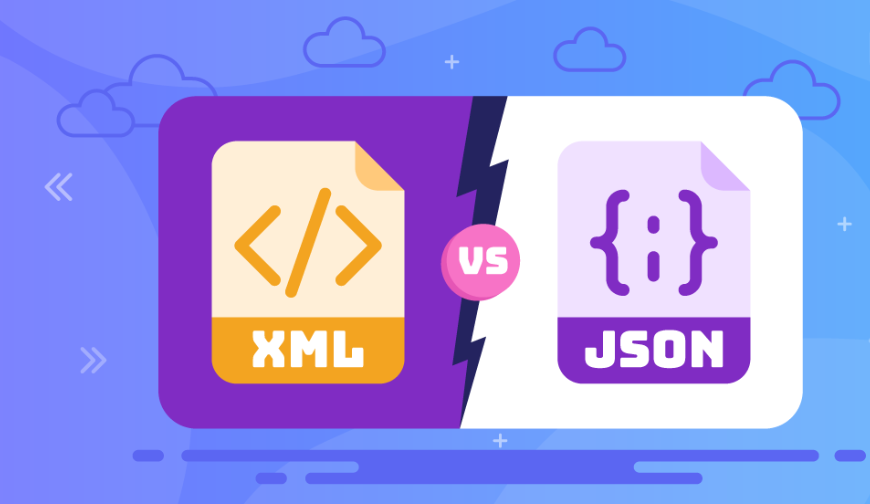
When it comes to exchanging data between applications, XML (Extensible Markup Language) and JSON (JavaScript Object Notation) are the two most popular formats. Developers, data engineers, and enterprises often face the question: Which one should I use?
In this article, we’ll compare XML vs JSON in terms of structure, readability, performance, and use cases, so you can make the right decision for your projects in 2025.
What is XML?
XML (Extensible Markup Language) is a markup language designed to store and transport structured data.
- Uses opening and closing tags (
<name>John</name>) - Self-descriptive and highly flexible
- Supports complex hierarchies and attributes
Example of XML:
<user>
  <name>John Doe</name>
  <email>[email protected]</email>
  <role>Admin</role>
</user>
What is JSON?
JSON (JavaScript Object Notation) is a lightweight, text-based format for representing structured data.
- Easy to read and write
- Works naturally with JavaScript and most modern languages
- Uses key-value pairs and arrays
Example of JSON:
{
  "name": "John Doe",
  "email": "[email protected]",
  "role": "Admin"
}
XML vs JSON: Key Differences
| Feature | XML | JSON |
|---|---|---|
| Readability | Verbose, uses tags | Clean, human-readable |
| Data Type Support | Strings only | Strings, numbers, booleans |
| Complex Structures | Great for nested data, attributes | Supports arrays & objects |
| Performance | Slower parsing in large datasets | Faster parsing, lightweight |
| Schema Support | XSD for validation | Limited schema validation |
| Use Cases | Enterprise, APIs, configuration | Web apps, APIs, data transfer |
When to Use XML in 2025
- Enterprise Integrations: SOAP web services, legacy systems
- Document Storage: Config files, structured documents
- Industry Standards: Healthcare (HL7), Finance (SWIFT), Publishing (RSS, Atom)
When to Use JSON in 2025
- APIs and Web Apps: REST APIs, mobile apps, modern frameworks
- Lightweight Data Transfer: Faster over networks
- Cloud & Microservices: Most cloud providers use JSON as default
Future Trends (2025 and Beyond)
- JSON continues to dominate in web and mobile development.
- XML remains strong in enterprise, finance, healthcare, and legacy systems.
- Hybrid approaches: Many APIs offer both XML and JSON options.
Conclusion
Choosing between XML and JSON depends on your project requirements:
- If you need simplicity, speed, and compatibility → go with JSON.
- If you need structured, standardized, and validated data → stick with XML.
Both are here to stay in 2025, but understanding where each shines will help you pick the right tool for the job.